Static vs Dynamic Websites: What Businesses Actually Need
Choosing the right website structure based on business goals, scalability, and long-term growth.
ALLWEB DEVELOPMENT & TECHNOLOGY
Vishal Rajput
2 min read
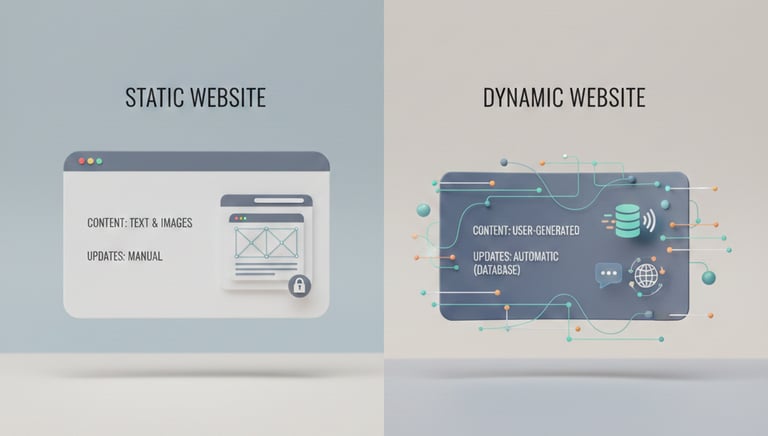
When businesses plan their online presence, one common confusion arises: Should we build a static website or a dynamic one? The answer isn’t about trends or technology hype—it’s about business needs. At Functioning Media, we guide clients to choose what actually works for their goals, not what merely looks impressive.
Let’s break it down clearly.
What Is a Static Website?
A static website consists of fixed pages where content remains the same unless manually updated. These websites are usually built using HTML, CSS, and minimal scripting.
Best suited for:
Small businesses
Portfolio websites
Informational or brochure-style websites
Landing pages
Key advantages:
Fast loading speed
High security (no database exposure)
Lower development and hosting costs
Simple structure and easy deployment
However, static websites are limited when frequent updates, user interaction, or scalability is required.
What Is a Dynamic Website?
A dynamic website generates content in real time using databases and backend logic. Content can change based on user behavior, inputs, or admin updates.
Best suited for:
Business websites with frequent updates
E-commerce platforms
Blogs and content-heavy websites
Web applications and dashboards
Key advantages:
Easy content management
User-specific experiences
Scalability and feature expansion
Integration with third-party tools and APIs
Dynamic websites require stronger architecture, regular maintenance, and proper security practices.
The Real Business Question to Ask
Instead of asking static or dynamic, businesses should ask:
Will content change frequently?
Do users need to interact with the site?
Will the website scale with the business?
Is automation required in the future?
A startup validating an idea may only need a static website. A growing brand, however, benefits far more from a dynamic system built on clean architecture.
Cost vs Value Perspective
Static websites are cost-effective initially, but limitations may lead to redevelopment later. Dynamic websites may cost more upfront, but they offer long-term value through flexibility and scalability.
The smartest approach is choosing what aligns with current needs while allowing future growth.
Our Practical Approach
At Functioning Media, we follow a simple principle:
Build static when simplicity and speed matter
Build dynamic when growth, automation, and scalability are priorities
We don’t upsell technology—we align it with business strategy.
Final Thoughts
There is no universal winner between static and dynamic websites. The right choice depends on your business model, growth vision, and operational needs. A website should not just exist—it should function as a business asset.
Choosing correctly today saves time, money, and technical debt tomorrow.
Address
Balewadi, Pune, Maharashtra, India
Contacts
functioningmedia@gmail.com
contact@functioningmedia.com
All rights reserved © Functioning Media 2026