How Website Speed Impacts SEO and User Psychology
Faster websites don’t just rank higher — they build trust, reduce anxiety, and drive better business decisions.
ALLWEB DEVELOPMENT & TECHNOLOGY
Vishal Rajput
2 min read
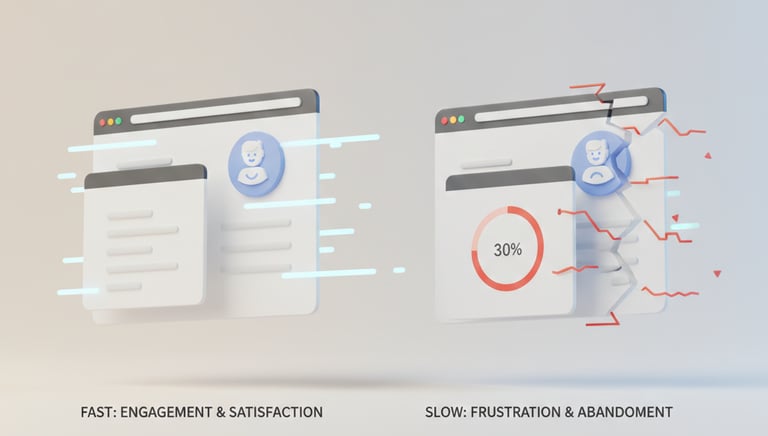
Website speed is no longer a technical luxury—it’s a core business factor. In an age of instant gratification, users and search engines both expect websites to load almost immediately. At Functioning Media, we’ve seen how performance directly influences rankings, conversions, and user perception.
Let’s explore why speed matters far beyond numbers and metrics.
Website Speed and SEO: A Direct Relationship
Search engines prioritize user experience, and speed is one of its strongest signals. Faster websites benefit from:
Better crawl efficiency
Lower bounce rates
Higher engagement metrics
Improved Core Web Vitals scores
When a site loads slowly, users leave quickly. Search engines interpret this behavior as dissatisfaction, which negatively affects rankings. Speed isn’t just a technical optimization—it’s an SEO necessity.
First Impressions Are Psychological
Users form opinions in milliseconds. A slow-loading website subconsciously communicates:
Unreliability
Poor professionalism
Low trust
Even before content appears, users emotionally judge the brand. A fast website creates a sense of control, clarity, and confidence—making users more likely to stay and explore.
Attention Span and Cognitive Load
Every extra second of loading time increases mental friction. Users experience:
Impatience
Frustration
Decision fatigue
Fast websites reduce cognitive load, allowing users to focus on content instead of waiting. This directly improves readability, comprehension, and action-taking.
Speed Influences Conversions
Whether it’s filling out a form, making a purchase, or reading a blog—speed impacts completion rates. Faster websites:
Increase conversion rates
Improve session duration
Reduce abandonment
A slow website silently kills opportunities without showing obvious errors.
Mobile Users Are Even Less Forgiving
With mobile-first indexing, speed on smartphones is critical. Mobile users often operate under:
Limited bandwidth
Distractions
Time pressure
If a site doesn’t load quickly on mobile, users simply move on—often to a competitor.
Speed Is a Trust Signal
Just like clean design and clear messaging, performance signals credibility. A fast website feels:
Well-managed
Secure
Professionally built
This trust directly impacts user decisions, especially for service-based businesses.
Our Performance-First Philosophy
At Functioning Media, website speed is treated as a foundation, not an afterthought. Our approach includes:
Clean architecture
Optimized assets
Performance-focused development
Scalable infrastructure planning
We optimize speed not just for search engines—but for human behavior.
Final Thoughts
Website speed sits at the intersection of technology, psychology, and SEO. It shapes how users feel, how search engines rank, and how businesses grow.
A fast website doesn’t shout—but it silently persuades, reassures, and converts.
Address
Balewadi, Pune, Maharashtra, India
Contacts
functioningmedia@gmail.com
contact@functioningmedia.com
All rights reserved © Functioning Media 2026